Listed
below are the films, TV shows, plays, biographies and novels that are about Soapy Smith or include an actor portraying him.
It is our hope that in the near future a well done movie will be made about Soapy's adventurous life and death.
An author speaking with Randolph J. Smith (Soapy's grandson) once said,
"A movie on Soapy Smith, would
be a mixture of, The Sting and Butch Cassidy and the Sundance Kid."
We could not agree more.
There are so many components of his life that would make a great film... drama, love, humor, violent confrontations and gunfights.
This would be without a doubt a winner of a movie. It's just waiting to be made.
THEATER
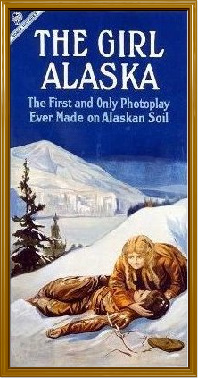
Title: The Girl Alaska Year: 1919 Producer: World Pictures Actor portraying Soapy:
None
American black and white silent film. Believed
to be the first motion picture that portrayed a mention of Soapy on film. The film caused Soapy's son, a newspaper man
and political power in St. Louis, Missouri, personal anguish and supposed loss of respect when the film was viewed in his
home town theater. In 1919 the son, Jefferson R. Smith, III hired the legal firm of McCarthy, Morris and Sachritz to take
up a legal battle of written letters meant to eliminate objectionable parts from the film.
Jefferson felt the film had injured his personal and political standing in the community and wished to suefor malicious libel. At first the film company, George Kleine Motion Pictures was willingto cut offensive scenes out but later renegedon their offer. The
one copy of the film that exists at the Library of Congress does not appear to be that offensive and may have had the objectionable
scenes deleted.
Paul Quinzi saw the film during a visit to the Library of Congress and wrote;
The film is the story of a girl called Molly McCrea, 'daughter of one of
the lost gold seekers of Alaska.' After having been abandoned by her father at a young age, Molly decides to travel to
Alaska herself after reading in the newspaper of 'great opportunities for young men in the north.' Disguised by a
pair of overalls and a cap, Molly passes herself off as a boy, stows away on a ship and adopts the slightly more masculine
name 'Alaska.' On the ship, Alaska meets Phil Hadley, who is also seeking his fortune, and the two 'boys'
become best buds.
The two arrive in
Skagway and meet an 'old sourdough' who shows them around the town. They soon hook up with a native who offers to
lead them to a good stake. On the way, a huge ice cliff falls on their canoe, killing their guide, leaving Phil and Alaska
to their own devices. (No CGI of course; the prelude to the film alludes to the actors 'missing death by a narrow margin'
in this scene). They eventually find the stake, but there's no gold to be found. They wander around some more and Phil
becomes ill. Alaska saves him by discovering, luckily within a few hundred yards, an old prospector's cabin. Lo and behold,
it's the old sourdough from Skagway! He takes them in and offers to let them stay and help work his claim.
Alaska seems to be slowly falling for Phil, who constantly pines for Lorraine,
his sweetie back home, a socialite who writes him occasionally. Of course, thinking Alaska is a dude, Phil is totally oblivious
to her feelings. One day Alaska, Phil and the sourdough go into Fairbanks, the nearest town, for supplies. Alaska and Phil
go into a saloon, where someone tries to rob Phil at the faro table. A great bar fight ensues, in which Phil is roundly beaten
and falls out into the street. Alaska rushes to his side, whispers 'I love you' and kisses the unconscious Phil. Then
the sourdough collects them and they make a swift exit from Fairbanks. They continue to work the stake, Phil missing Lorraine,
Alaska lamenting her unrequited love for Phil. The old sourdough falls ill, and on his death bed asks Alaska to take his share
of the claim back to the States and give it to his little girl, Molly! Alaska removes her cap, revealing her curls, and no
sooner are father and daughter reunited than they are separated by death.
Phil decides it's time to head back home to Lorraine, and leaves his buddy Alaska to work the claim. He is
thrown from his sled and is left alone in the wintry wilderness. The next morning, Alaska wakes to the jingling bells of the
returning pilotless dogsled, and goes out to save Phil, which she does, although admittedly still bitter about his having
left her for Lorraine.
Spring comes, and
one day Phil spies Alaska secretly frolicking by the lake, naked as the day she was born, highlighting the fact that she's
a she (no CGI here, either, but shot from far away). Later that day, some prospectors happen by the cabin and leave off some
newspapers from the States. Phil picks up one only to read, 'Prominent socialite Lorraine Dower weds New York millionaire.'
Next morning, Phil takes Alaska to Fairbanks, ostensibly to file a new claim. Instead, he takes her directly to the chapel
(pastored by the Rev. U.R. Blest), whereupon he announces that they want to be married, to which Alaska coyly consents. THE
END.
So what about Soapy?
Of course, the reason I wanted to see this film in the first place was to see
the first on-screen portrayal of Soapy Smith. My understanding of the connection to Soapy was that his son was so embarrassed
and offended by the film that he threatened to sue the producer for libel if he did not remove the objectionable scenes. I
have concluded that either he succeeded, or that the lawsuit itself may have been Soapy's last con - from beyond the grave.
First, there is no Soapy character,
or even a character loosely based on Soapy (a la Candy Johnson in Honky Tonk, Sheriff Gannon in The Far Country) in the film.
The only mention of Soapy is an approximately 15-second scene when Phil and Alaska arrive in Skagway. The entire part plays
exactly like this:
Slide: The old sourdough
takes Alaska and Phil to the grave of the notorious gunman, Soapy Smith.
Screen: [Shows Soapy's tombstone, circa 1919, tattooed with graffiti] Jefferson R. Smith, died July 8, 1898,
aged 38 years.
Slide: 'This fellow tried to shoot
up Skagway. They buried him with his boots on.'
Of course, it's possible that some original version had a somehow more sinister depiction of Soapy and after
being threatened with a lawsuit, the director removed it, leaving only the cut I saw. But the film is set in 1919, so it's
unlikely that there would have ever been a Soapy character included in it.
Title: Call of the Wild Year:
1935 Producer: Twentieth Century Pictures Actor playing Soapy: Harry Woods
An American black and white film adaption of Jack London's book of the same name, about a prospector heading
north to the Klondike gold rush who rescues a sled dog from its cruel master. Clark Gable and Loretta Young star.
The Turner Classic Movies website writes the following synopsis for the film.
In Skagway in the Yukon, in 1900
during the gold rush, prospector Jack Thornton plans to return to his hometown of Chicago but loses all his money in a card
game. "Shorty" Hoolihan, a New Yorker just released from jail after a six-month sentence for tampering with the
mail, tells Jack about a letter he read that was sent by an ill prospector, Martin Blake, just before he died to his son John
in San Francisco, which contained a map showing the location of a gold mine. Shorty has drawn the map from memory, and although
he concedes that it may be faulty in spots, he talks Jack into becoming his partner after telling him that John Blake and
his wife left Skagway that day in search of the mine. While buying a dog team, Jack and Shorty encounter a wealthy, sadistic
English prospector, Mr. Smith, who wants to buy an untamed St. Bernard named Buck, so that he could shoot him. Jack, who admires
the dog, buys him instead, and although Buck runs away once he is freed on the trail, he returns at night in the whirling
snow and curls up beside Jack. After they come across Blake's wife Claire surrounded by wolves, she explains that Blake
has been gone two days searching for food. Believing that Blake is dead, Jack forces Claire to come with them to Dawson. He
and Claire grow fond of each other on the trail, and at Dawson, Claire agrees to become partners with them to find the gold.
Although they need money to buy an outfit, Jack, after having lost most of their provisions crossing a river, refuses to sell
Buck to Smith; however, after Jack gets drunk and brags that Buck can pull a sled loaded with 1,000 pounds 100 yards, Smith
wagers $1,000 against Buck that he cannot. Jack accepts and Buck barely succeeds before he collapses in Jack's arms. As
they leave Dawson, Blake, unknown to them, is brought in barely alive. At night, Jack pensively stares at Claire by the fire
and explains his acceptance of the "Law of the Klondike" -- if there is something you need, you grab it -- which
Claire does not accept. Soon they find the gold, and Shorty is sent to file a claim. As the winter approaches, Buck is tempted
by the call of nearby wolves, while Jack and Claire, alone in an isolated cabin, acknowledge and consummate their love. Meanwhile,
Blake leads Smith to the gold. When they find the cabin, Smith orders one of his men to knock out Blake. Smith then takes
the gold from Jack and Claire at gunpoint but dies with his men when their canoe overturns in rapids and the gold weights
them down. After Buck finds Blake, Jack carries him to the cabin, where he and Claire nurse him to health. Although Jack tells
Claire that he is keeping her, he relents after she explains that although she loves him, Blake needs her and that she lives
by a different law than Jack. After the Blakes leave, Buck joins the wolves and becomes a father, and Jack is left alone for
the winter, but in the spring, Shorty returns with an Indian woman, whom he won in a crap game, to be their cook.
Title: Honky Tonk Year: 1941 Producer: Metro-Goldwyn Mayer Actor
portraying Soapy: Clark Gable
An American black & white film starring Clark Gable, Lana Turner,
Frank Morgan, Claire Trevor and Chill Wills. MGM purchased the rights to the book, The Reign of Soapy Smith, by William
Ross Collier and Edwin Victor Westgate and transcribed into a cinema play by Ann Lee Whitmore and Tom Sellers, with Clark
Gable playing the lead (L.A. Times, 04/29/1940. p. 8). The film was to be about Soapy, but according to Jeff,
his grandfather, Soapy's son, (Jefferson Randolph Smith, III) threatened to open a lawsuit against MGM if they used his
father's name and story.
Soapy's son still had rights over usage of his father's name. Rather
than scrap the movie, which had already begun filming, MGM just changed the names around. Soapy Smith became Candy Johnson,
a con man, played by Clark Gable. Candy Johnson, tired of running from town to town, sets his mind to have a town of his own.
A very fun film with great comical dialogue and a few shootouts thrown in for flavor.
At the startof the
film there is a beautiful rendition on three-card Monte, the game that was instrumental in the real Soapy's death.
In the film Gable, as Mr. Johnson, for the sake of a woman, decides to use his huckstering skill to build a small-town
church, but soon he's up to his old tricks, again, managing a dance hall and gambling emporium.There is a happy
ending.
Below is the opening scene for Honky Tonk showing Clark Gable as Soapy doing three-card Monte.
By Douglas Churchill Special to THE NEW YORK TIMES.
HOLLYWOOD, Calif., April 28, 1940--Clark
Gable will play the lead in "Soapy Smith," which Pandro S. Berman will produce for Metro, the studio announced.
The story, based on "The Reign of Soapy Smith," by Edwin Victor Westrate and William Ross Collier, deals with the
...
LOS ANGELES TIMES, April 29, 1940--Clark
Gable will be the star in one of the earliest pictures produced by Pandro Berman for the M.G.M. studio. The film scheduled
for this star features Soapy Smith, one of the characters celebrated in early Colorado history. "The Reign of Soapy Smith,"
written by William Ross Collier and Edwin Victor Westgate, has been purchased by the studio and will be transcribed into a
cinema play by Ann Lee Whitmore and Tom Sellers, two of the younger writers at the establishment.
Title: The Great Jesse James Raid Year: 1953 Producer:
Jezebel Productions Actor portraying Soapy: Earl Hodgins
Jesse James (Willard Parker), retired and living
under an assumed name in St. Joseph, Missouri, agrees over the protests of his wife Zee (Barbara Woodell) to join Bob Ford
(Jim Bannon) and Sam Wells (Richard Cutting)in a Colorado gold raid. Jesse rounds up gunman Arch Clements (Tom Neal); demolition
expert Elias Hobbs (Wallace Ford), with suspect credentials as he later blows himself up; and get-away wagon driver Johnny
Jorette (James Anderson). They rendezvous at Ford's saloon in Creede, Colorado, where Ford's girlfriend Kate (Barbara
Payton) joins the gang. Sam guesses Ford's plan to double-cross Jesse and collect a reward and Ford kills him. Lots of
other people die before Jesse and Ford ride off in opposite directions. Written by Les Adams
Title: The Far Country Year: 1955 Producer: Universal International Pictures Actor
portraying Soapy: John McIntire
In 1896, Jeff Webster (James Stewart) sees the start of the Klondike gold rush
as a golden opportunity to make a fortune in beef...and woe betide anyone standing in his way! He drives a cattle herd from
Wyoming to Seattle, by ship to Skagway, and (after a delay caused by larcenous town boss Gannon, loosely, but clearly and
unmistakably, based on Soapy, played by John MacIntire) through the mountains to Dawson. There, he and his partner Ben Tatum
get into the gold business themselves. Two lovely women fall for misanthropic Jeff, but he believes in every-man-for-himself,
turning his back on growing lawlessness...until it finally strikes home. Written by Rod Crawford.
Title: The Klondike Fever Year:
1980 Producer: CFI Investments Actor portraying Soapy: Rod Stieger
This film is supposed to chronicle Jack London's epic journey
from San Francisco to the Klondike gold fields in 1898. Soapy Smith is a main character but it is obvious that the writers
either never picked up a history book on the gold rush or chose to ignore everything they read.
TELEVISION
Title: The Alaskans Year: 1959 - 1960 Producer: Warner Brothers Actor portraying
Soapy: John Dehner
When gold was discovered in the Yukon in the 1890's,
thousands of hopeful prospectors headed north for a chance at becoming rich. The easiest passage to the Yukon was through
the small Alaskan port town of Skagway, which quickly exploded into a sprawling boom town, offering almost everything a miner
could want, for a price. Adventurers Silky Harris and Reno McKee have arrived in this town looking to make their fortunes.
Not mining for gold, but by catering to and fleecing the hardy, hard-living miners who pass through town. Written by Jean-Marc
Rocher.
Several episodes included Soapy in some form of dishonest mayhem. One of the episodes, "Remember the Maine"
tells the story of Soapy and his volunteer army.
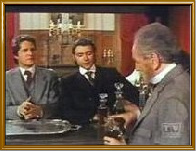
Title: Alias Smith
and Jones Year: 1971 - 1972 Producer: Universal TV Actor portraying Soapy: Sam
Jaffe
American TV show based on two outlaws (Hannibal Heyes and Kid
Curry) trying to go straight with the law. They are popular with everyone except the railroads and the banks. They are
offered an amnesty on condition that they stay out of trouble for a year and that they don't tell anyone about it. With
a view to keeping their noses clean they adopt the identities of Smith and Jones and use all of their ingenuity keeping out
of the way of the law.
Sam Jeffe plays the part of Soapy in three episodes:
1.) The Great Shell Game (aired February 18, 1971)
2.) A Fistfull of Diamonds (aired March 4, 1971) 3.) Bad Night in Big Butte (aired March
2, 1972)
Title: Deadwood Year: 2004
- 2006 Producer: HBO Actor portraying Soapy: Gil Gayle
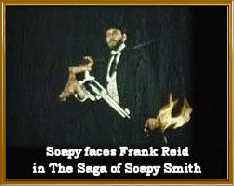
Title: Treasure/The Saga of Soapy Smith Year: 1968 Producer: Burrud Productions Actor portraying Soapy: Unknown
The Saga of Soapy Smith aired on Bill Burrud's Treasure.
Well done portrayal of his Skagway days leading up to his death. The question arises as to the where Soapy's wealth
went after his death. It is hard to fathom that Soapy died broke when at the height of power. His widow claimed he was worth
millions.
THEATRICAL PLAYS
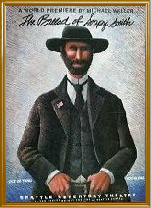
Title: The Ballad of Soapy Smith Year: 1983 Producer: Micheal Weller Actor
portraying Soapy: Denis Arndt
A wonderful play written by Michael
Weller and premiered in Seattle, Washington in 1983. It was performed in New York and years later in a college university
in California, where Jeff Smith had the pleasure of seeing the play and meeting Mr. Weller.
BALLAD OF SOAPY SMITH
- Play in three acts by Michael Weller, directed by Robert Egan, scenery by Eugene Lee, costumes by Robert Blackman, lighting
by Spencer Mosse, songs by Michael Weller, score by Norman Durkee, produced by the Seattle Repertory Theater, Seattle, Wash.,
through Nov. l9.
SEATTLE - Michael Weller's "The Ballad
of Soapy Smith" is a Gold Rush melodrama about a legendary con man known - rather more staidly - as Jefferson Randolph
Smith (l860-l898). If, in its world premiere at the Seattle Rep, Weller's sprawling epic seems perfectly suited to its
rustic but sophisticated Northwestern setting, that's not by accident. The script was developed last year during a Seattle
Rep workshop, then chosen to open the company's impressive new $l0-million theater. Beyond this cosy provincialism, "Soapy
Smith" is a rip-roaring play about megalomania and power, a Wild West show with something more on its mind than six-shooters
and revenge.
Weller picks up his charismatic hero just a year before
his death. As a somewhat mysterious presence in the Klondike, Smith arrives in Skagway, Alaska, alert to the town's possibilities.
(Memorably described by Jack London, Skagway was a way-station leading to the Yukon gold fields.) Perfectly willing and eloquently
able to pan gold dust out of the palms of prospectors, Smith elects a more devious plan. With steady assurance and easy reliance
on hypocrisy, he becomes - or appears to become - a benevolent townsman, "Good Citizen Smith." By any definition
he's the ultimate politico, a grafter sliding by on charm while grasping everything in reach. The subtext of Weller's
play is an instant-history on the making of a politician. As someone says of him, Soapy Smith bends "truth into shapes
never before seen on this earth."
As a cover he owns and operates
a restaurant, Jeff Smith's Oyster Parlour. His coterie includes con artists like himself, and the town's madame. He
forms his own "army" as a force against the moralizing (yet murderous) Skagway vigilantes. He wins friends and influences
people, including an upstanding citizen named Burke Gallagher who, despite his admiration of Smith, sees him for what he is.
As Weller has constructed his play, Gallagher is Smith's nemesis; in vague Pirandellian shadows, he's also Smith's
dormant conscience. Although Smith never rises beyond self interest, never advances so much as a small step toward nobility,
he eventually becomes troubled by his lack of soul. At one point he says, "If I'm truly no more than what I am now,
it's been a sorry little journey indeed." He knows his life has been "bullshit" and: "All the way
to hell he sees clearly what he is."
Michael Weller tells Soapy
Smith's story through the device of a narrator, Paul Anthony MacAleer, a minor poet given to doggerel. (Weller credits
MacAleer's verse as part of the play's inspiration.) The device is effective principally because MacAleer is not just
an outside observer, not just someone bearing witness; instead, as an "uncultured dirt-farmer from Nebraska," he's
a fully developed character whose life in Skagway is pivotal to the plot. MacAleer's thickly sentimental poem about Smith
is, finally, revealed for what it is, dumb, sugary versifying, the opposite side of the far more complicated, vinegary truth.
This revelation, by the way, is made by MacAleer's subject himself. Soapy Smith has been educated, he knows "The
Aeneid," and he's brash enough to describe poetry as good propaganda. But when he hears MacAleer's couplets,
he describes them as "rhyming flapdoodle."
Beneath the often
familiar scenes of Weller's play (backroom skulduggery, streetside brawls, political meetings, whispering whores, hang-'em-high
justice), there's a still familiar but sharply dramatic focus. "The Ballad of Soapy Smith" is not merely about
"the vital spirit that marks the adventurous beginnings of the Pacific Northwest," as one Rep press release has
it. In a very real sense Weller's play is about the contradictions that are the basis for the whole country. Weller's
play begins in easy, beguiling myth (MacAleer's awful honorific) and ends in brute reality (Soapy Smith's murder).
What we witness en route is not America's coming of age but, rather, the repetitions of history as old as the con artistry
of Julius Caesar and as new as the bunko oratory of Ronald Reagan. Michael Weller finds raucous splendor in his epic (that's
the come-on, the entertainment), then, to his credit, he plays it cool, cynical, straight.
Under Robert Egan's direction "The Ballad of Soapy Smith" has been given exactly the
bustling production it needs. Eugene Lee's set is an open-rafter marvel (with a huge blow-up of the snow-capped Klondike
just up a center-stage ramp), a variant copy of other timbered sets Lee has done for the Trinity Square Repertory. Denis Arndt
is wonderful as Soapy Smith; spellbinding, in fact, and good enough to make us care about this corrupt and venal man. Denis
Arndt catches Soapy Smith's larger-than-life radiance and plays it for a kind of low voltage ease. Ted D'Arms is fine
as Burke Gallagher, whose goodness owes a debt to a dark secret. Christopher Cooper is fine, too, as MacAleer, and there's
good work from Kate Mulgrew, Paul Hofstetl, Kevin Tighe. The cast has 33 actors, and there are some less than ideal performances
but the level of acting is pretty admirable.
The Ballad of Soapy Smith
is probably too big, too populous for Broadway, and it doesn't belong there in the first place. As an example of homegrown
regional theater, it has its own weight and conviction. It sings a variant song of a man - and a country - trapped in his
own myth and inevitably paying the price. It's the Faust legend echoing from purple mountain majesty, from sea to shining
sea.– Kevin Kelly of The Boston Globe, November 16, 1983.
Title: The Days of '98 Show Year: 1925 - Present Producer: Gold Rush Productions
(Jim Richards) Actor portraying Soapy: varies
Although
we are great fans of the show we are not affiliated. For ticket & general information please see their website. DAYS OF '98 SHOW
The Days of 98 Show in Skagway, Alaska is a one-hour historic musical comedy drama
based on the Skagway adventures of Soapy Smith. The show is seen each summer by thousands of tourists.
Jim Richard's says in an interview with the local radio station, "We are taking a little artistic license
by putting a show on in Soapy’s saloon, which would be more or less indicative of the shows that were put on during
the 1890’s with appropriate turn of the century music. We run through the demise of Soapy Smith. We get his name going
first; we let people know about how he got his name. Then it switches immediately to his bar here in Skagway. And it’s
his last day, and he’s absolutely losing it, and he goes off and gets killed."
Where:
The Eagles Hall (Fraternal
Order of Eagles, Aerie 25) at Sixth and Broadway, Skagway, Alaska. The show has been performing in the Hall for over 25 years.
The Eagles Hall was built using the sides of the Mondimen Hotel, in which Soapy lived. It is said that the Eagles Hall is
haunted by the ghosts of gold rush era. The Eagles Hall is also host to the annual Soapy Smith Wake held every July 8 in honor
of the day Soapy was shot.
When:
18 to 20 shows a week during the summer months when tourism is at its' peak. The evening shows are often preceded
by mock gambling with "Soapy's money." The competition is high at the original roulette table, black jack, dice
game and faro. Performances are schedule to match the arrival and departure of the cruise ships.
History:
The production has been running for over
80 years which makes it the longest running show in Alaska. The show has been a tradition for most of its 80-plus years.
The show got its beginnings as dances staged at the White Pass Athletic Club for visitors in the 1920s to raise money for
the hockey team. When the club shut down, the back bar and the show moved uptown to the Eagles Hall. Many charter Auxiliary
members were part of the original cast of musicians and can can dancers. The show has evolved from a cast of Eagles volunteers
to paid professionals.
Jim Richards and Gold Rush Productions, the owners of the show, take pride in the fact that
they hire only professional actors and musicians for the show. Richards has been apart of the show for nearly three decades.
ELECTRONIC GAMES
Title: Gun Year: 2005 Producer: Neversoft & Activision Inc. Actor portraying
Soapy: Computer generated
Gun is a western-themed video developed by Neversoft and published by
Activision for the Xbox 360, Xbox, GameCube, PC, PSP and PSP2. It was released in North America on November 8, 2005 and in
mid-to late November in Europe. Soapy Jennings is one of the characters in the game named after Soapy Smith. It is unknown
why they changed his name but one rumor states it was in honor of one of the creators friends.
As Colton White, players must straddle the line between good and evil as they showdown
against corrupt lawmen, a murderous preacher, renegade army psychopaths, merciless outlaws and unforgiving Native Americans,
while waging war on horseback, collecting bounties, and commandeering trains. Players travel through an action-packed
landscape of high mountain wilderness, deserts and bustling territorial towns in an epic story of betrayal, greed, and revenge.
Soapy (voice by Dave Wittenberg) is a safe-cracking card cheat and the main characters (Colton) closest ally. Soapy
is a little too smart and cocky for his own good. Though he's a smooth talker, he tends to get himself into trouble, where
as Cole is constantly bailing him out.
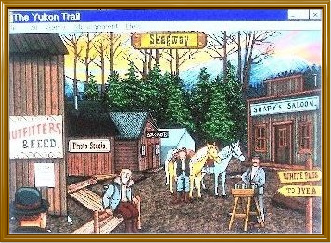
Title: The Yukon Trail Year: 1994 Producer: The Learning Company Actor portraying Soapy: Computer generated
The Yukon Trail
A Windows/Mac computer game in which the player is a Klondike gold rush stampeder trying to
get to Dawson and the gold fields to make a fortune. In Skagway the player runs into Soapy Smith, his saloon, a crooked
shell game and a card cheat.
The Yukon Trail begins in July 1897 on the wharf in Seattle, Washington, the jumping-off
point for thousands of stampeders. If you're smart, persistent, and just a little lucky, you'll make it to Dawson
City, headquarters of the gold rush. There you can set out on your own to dig for gold.
Along the way, all kinds
of people will want to give you advice. But be careful who you listen to! Some people have valuable advice. Others don't
know what they're talking about. And still others are trying to cheat you.
Meet actual historical figures,
like Soapy Smith, as well as fictional characters that represent the types of people you might have encountered.
Title: Conker, Live and Reloaded Year: 2005 Producer: Rare Ltd. Actor
portraying Soapy: Computer generated squirrel
Conker:
Live and Reloaded is an Xbox game, that Jeff played with his son Jefferson. When in the "Total War" portion of the
game, players team up against a sea landing force of enemy squirrels. The names of each character is visible in white letters
above the heads for identification purposes.
One day, Jefferson and
I were in the heat of battle in the game. we were the bank of a trench when, in a blur I something that caught my attention.
A squirrel flew by in a blur just below us, in a trench. I startled my son by yelling, "Did you see that?"
Before he could answer, I took off chasing the squirrel down the winding trench. My son, now mad and yelling at me for
deviating from the game, was trying to keep up. Finally, I trapped my prey in a cul-de-sac.
Look
at the name of the character I was chasing, Jeff! I hollered excitedly. The name above my captives head read "Soapy."
Not really knowing, or caring whether "Soapy" squirrel was friend or foe, I did the only thing I could do in that
predicament...I shot "Soapy squirrel" dead.
MUSIC
The Ballad of Soapy Smith, 1981, written by Al Oster.
The Ballad of Soapy Smith, 1987,
written by Tim Martin.
The Bloody Ballad of Notorious Bad Man Soapy Smith’s Wretched and Violent Demise,
2008, written by Ed Parrish.
BOOKS
NON-FICTION
Clifford, Howard, Uncrowned King of Skagway, Sourdough
Enterprise, 1997. Well published with common mistakes. Has a different perspective of Soapy's death and who shot him.
Howard is a friend of the Smith family having met John Randolph Smith and Jeff Smith in 1973.
Haigh, Jane, King Con: The Story of Soapy Smith, Friday501, 2006. Book review.
Pullen, Harriet S., Soapy Smith Bandit
of Skagway: How He Lived; How He Died. Stroller's Weekly Print (Elmer J. White - believed to be a member of the Soap Gang).
early 1900s (unknown publication date).
Robertson,
Frank G. and Beth Kay Harris, Soapy Smith: King of the Frontier Con Men, Hastings House, 1961. Probably the best
biography made to date.
Shea & Patten,
The Soapy Smith Tragedy, Daily Alaskan Print, 1907 (this is the Daily Alaskan newspaper which published Soapy's death
in July, 1898).
Westrate, Edwin Victor
and William Ross Collier, The Reign of Soapy Smith: Monarch of Misrule, Doubleday, Doran, 1935. The first complete
biography. No footnotes, resources given.
FICTION
Walt Disney Comics, Uncle
Scrooge, Marvel, June 1994. This is the story of how Scrooge McDuck (Uncle Scrooge) obtained his riches, all thanks to
Soapy Slick (Soapy Smith). Scrooge goes to Skagway where he buys a fraudulent mine claim from Soapy. When Scrooge finds gold
on the claim Soapy tries to claim the mine back.
Fats, A. Conan, The Adventure
of the Grace Ghost, Greater Grace Daily Online Gazette. A. Conan Fats, a descendant of English mystery writer A. Conan
Doyle, author of Sherlock Holmes stories, continues the family tradition of writing. This time Soapy is the villain in The
Adventure of Grace Ghost.
Ford, John M., How Much For Just The Planet? Pocket
Books, 1987. Soapy is not a character in this book, but a Star-trek Federation Starship in the year 2268. The U.S.S. Jefferson
Randolph Smith (NCC-29402, Sulek-class) is a Federation resource exploratory ship under the command of Captain Tatyana Trofimov.
From the same novel there are other ships named after the Klondike era, such as the U.S.S. Dawson City. It appears John did
a little research into mining for the novel. It also appears Ford had a sense of humor.
Miller,
Mike, Soapy, Alaskabooks, 1970. A fun fictional paperback read.
Markstein,
George, Tara Kane, Stein & Day (Scarborough House), 1978.
Fats, A. Conan, The
Adventure of the Grace Ghost, Greater Grace Daily Online Gazette. A. Conan Fats, a descendant of English mystery writer
A. Conan Doyle, author of Sherlock Holmes stories, continues the family tradition of writing. This time Soapy is the villain
in The Adventure of Grace Ghost.
Ford, John M., How Much
For Just The Planet? Pocket Books, 1987. Soapy is not a character in this book, but a Star-trek Federation Starship in
the year 2268. The U.S.S. Jefferson Randolph Smith (NCC-29402, Sulek-class) is a Federation resource exploratory ship under
the command of Captain Tatyana Trofimov.
From the same novel there are other ships named after the Klondike era, such as
the U.S.S. Dawson City. It appears John did a little research into mining for the novel. It also appears Ford had a sense
of humor.
Miller, Mike, Soapy, Alaskabooks, 1970.
A fun fictional paperback read.
Markstein, George, Tara
Kane, Stein & Day (Scarborough House), 1978.
WOULD YOU LIKE TO KNOW MORE?
read Alias Soapy Smith: The Life and Death of a Scoundrel



 American black and white silent film. Believed
to be the first motion picture that portrayed a mention of Soapy on film. The film caused Soapy's son, a newspaper man
and political power in St. Louis, Missouri, personal anguish and supposed loss of respect when the film was viewed in his
home town theater. In 1919 the son, Jefferson R. Smith, III hired the legal firm of McCarthy, Morris and Sachritz to take
up a legal battle of written letters meant to eliminate objectionable parts from the film.
American black and white silent film. Believed
to be the first motion picture that portrayed a mention of Soapy on film. The film caused Soapy's son, a newspaper man
and political power in St. Louis, Missouri, personal anguish and supposed loss of respect when the film was viewed in his
home town theater. In 1919 the son, Jefferson R. Smith, III hired the legal firm of McCarthy, Morris and Sachritz to take
up a legal battle of written letters meant to eliminate objectionable parts from the film.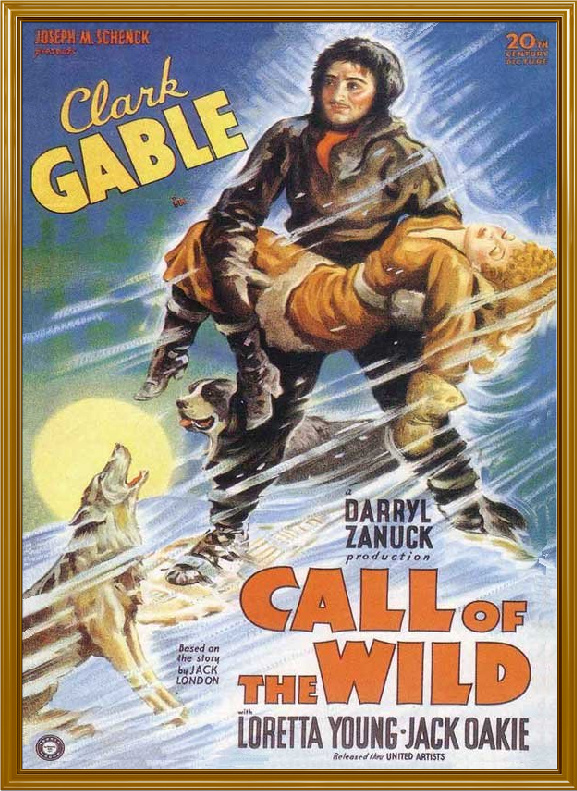 An American black and white film adaption of Jack London's book of the same name, about a prospector heading
north to the Klondike gold rush who rescues a sled dog from its cruel master. Clark Gable and Loretta Young star.
An American black and white film adaption of Jack London's book of the same name, about a prospector heading
north to the Klondike gold rush who rescues a sled dog from its cruel master. Clark Gable and Loretta Young star.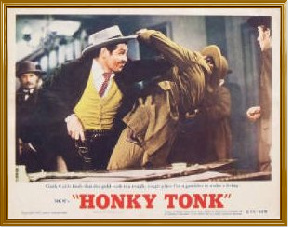 An American black & white film starring Clark Gable, Lana Turner,
Frank Morgan, Claire Trevor and Chill Wills. MGM purchased the rights to the book, The Reign of Soapy Smith, by William
Ross Collier and Edwin Victor Westgate and transcribed into a cinema play by Ann Lee Whitmore and Tom Sellers, with Clark
Gable playing the lead (
An American black & white film starring Clark Gable, Lana Turner,
Frank Morgan, Claire Trevor and Chill Wills. MGM purchased the rights to the book, The Reign of Soapy Smith, by William
Ross Collier and Edwin Victor Westgate and transcribed into a cinema play by Ann Lee Whitmore and Tom Sellers, with Clark
Gable playing the lead (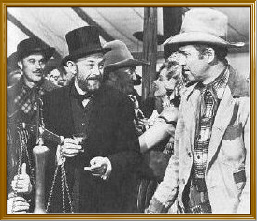
 American TV show based on two outlaws (Hannibal Heyes and Kid
Curry) trying to go straight with the law. They are popular with everyone except the railroads and the banks. They are
offered an amnesty on condition that they stay out of trouble for a year and that they don't tell anyone about it. With
a view to keeping their noses clean they adopt the identities of Smith and Jones and use all of their ingenuity keeping out
of the way of the law.
American TV show based on two outlaws (Hannibal Heyes and Kid
Curry) trying to go straight with the law. They are popular with everyone except the railroads and the banks. They are
offered an amnesty on condition that they stay out of trouble for a year and that they don't tell anyone about it. With
a view to keeping their noses clean they adopt the identities of Smith and Jones and use all of their ingenuity keeping out
of the way of the law. 
 The Saga of Soapy Smith aired on Bill Burrud's Treasure.
Well done portrayal of his Skagway days leading up to his death. The question arises as to the where Soapy's wealth
went after his death. It is hard to fathom that Soapy died broke when at the height of power. His widow claimed he was worth
millions.
The Saga of Soapy Smith aired on Bill Burrud's Treasure.
Well done portrayal of his Skagway days leading up to his death. The question arises as to the where Soapy's wealth
went after his death. It is hard to fathom that Soapy died broke when at the height of power. His widow claimed he was worth
millions.