|
|
 |
|
The history you are about to read has been well researched
by numerous members of the Smith family for many decades. We grew up knowing that a prominent bad man had a place on our family
tree. In the early years family members tried desperately to protect and polish the reputation of Jefferson Randolph Smith II, alias Soapy Smith. Today, more family members just want the truth to be known,
both the good with the bad.
We family members are fortunate that Soapy left a
large amount of his paperwork intact for us to study. Because of his businessman like files we have a wealth of literally
thousands of original documents and letters to utilize in our research efforts. Thousands of hours have been spent reading
the pages of microfilm newspapers from Colorado and Alaska.
This site is not complete
by any means, nor is it a detailed history. Details and answers are fully exposed and explored in Jeff Smith's
biography, Alias Soapy Smith: The Life and Death of a Scoundrel.
It is important that
the reader understand that we are first and foremost, historians, striving for the truth. We are well aware that Soapy Smith
was not one of the "good guys." We are not proud of the bad that he did, but rather what he left behind and the
lessons he taught us.
Due to lack of space this
site does tend to focus on his bad deeds more so than his good ones. Let it be known that it is a recorded fact that Soapy was a large and well known contributor to charity. His aid to good causes is not
to be taken as an attempt to defend his crimes.
 "I consider bunco steering more honorable
than the life led by the average
politician."
Jeff R. Smith, The Road, 02/29/1896.
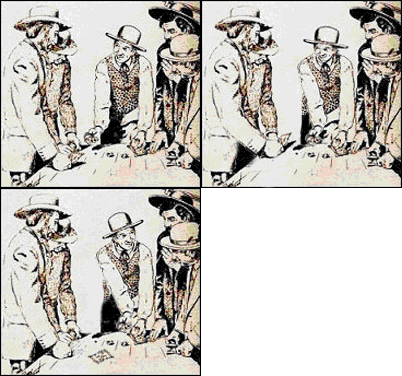
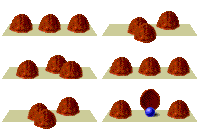
| THE SHELL GAME |
|
| courtesy: Bob Wood |

THE EARLY
YEARS
1860
- 1879
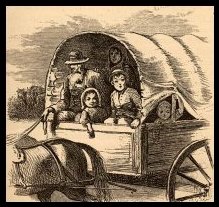
Jefferson Randolph Smith II was perhaps the most notorious confidence man of 19th
century American history. He was born in Coweta County, Georgia, near the town of Newnan in 1860. His ancestry was English.
The Smith's had come to America around 1760 and settled in Virginia. In 1821 Jefferson's grandfather moved his family
to Coweta County. The Civil War (1860-1865) destroyed much of the wealth the family had amassed. They struggled during the
Reconstruction years to adjust. When Jefferson was about 16 (1876) his
parents gathered up their belongings and moved to Round Rock, Texas in an attempt to improve their lives.
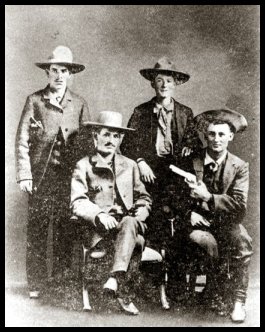
| Courtesy of Robert G. McCubbin, jr. |
|
| Sam Bass Gang |
Jefferson and his cousin Edwin "Bobo" Smith witnessed
the fatal wounding of Texas outlaw Sam Bass and members of his gang on July 19, 1878. It was during this time that
Jefferson was introduced to the world of the bunco brotherhood. Around 1878 young
Jefferson moved from his family and set out on his own as a "sure-thing" man. He traveled around the country following
fairs selling cheap trinkets and fake jewelery as a "Cheap John." He soon learned short con games such as the shell
game and three-card Monte. Jefferson had become a confidence man and a scoundrel.
|
|
Jefferson had a gift for organization. While at Fort Worth, Texas, Jefferson began to form the core of his bunco gang that became known across the
west as the Soap Gang, a very close assortment of intelligent
confidence men. Each had his own unique and specialized talents for separating victims (dupes) from their money. Alone, these men were forced to be drifters, moving from one town to the next,
but Jefferson united the men and together as an organization they were harder
to stop. Jefferson combined their assets, bribed policemen and politicians, and bought the best legal representation his money
could buy. He successfully made it more difficult to put and keep his men in a jail. Jefferson
found that the concept of law and order actually worked in his favor. According to his cousin,
Edwin Bobo Smith, Soapy's swindles were so well
known that Fort Worth enacted new legislation due specifically to Soapy's activities. Soapy decided to move on to bigger
and better things. Soapy stated that he first arrived in Denver,
Colorado some time in 1879. Jefferson liked Denver's wide-open policy towards gambling.
The lack of being able to keep up with it's own growth made Denver a haven for bunco gangs. The Union Station train depot
was busy day and night bringing in fresh victims (known as sheep) for the bunco gangs
to shear. Jefferson combined many of the loosely knit bunco men working the city into his organization and his influence at
city hall and the police department grew along with the size of his gang. By 1884 Jefferson
was able to proclaim himself boss of Denver's underworld empire of crime.oapy stated
that he first arrived in Denver, Colorado some time in 1879. Jefferson liked Denver's
wide-open policy towards gambling. The lack of being able to keep up with it's own growth made Denver a haven for bunco
gangs. The Union Station train depot was busy day and night bringing in fresh victims
(known as sheep) for the bunco gangs to shear. Jefferson combined many of the loosely knit bunco men working the city into
his organization and his influence at city hall and the police department grew along with
the size of his gang. By 1884 Jefferson was able to proclaim himself boss of Denver's underworld empire of crime.
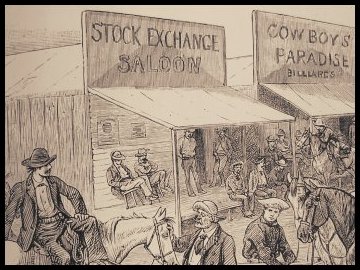
|
| Hell's half acre (Fort Worth) |
Jefferson Smith had transformed
from a quaint on-the-road flim-flam man, to that of a prominent big time gangster. The
gang was infamously known on their recognizance. There were perhaps as many as 100 steerers working
for Soapy such as "Reverend" John Bowers, whom at times performed the part of
a saintly man of cloth. "Professor" William Jackson often times portrayed a mine and mineral
expert. For protection there were the hard core gunfighters like "Texas Jack" Vermillion of Wyatt Earp/Tombstone,
Arizona fame. "Big Ed" Burns, the Leadville, Colorado bunco boss was there as well
as "Sure-shot" Tom Cady and a few dozen more cold hearted ruffians making up the rank
and file. Each of these scoundrels have their own story of fame. Saloon
proprietors were often paid a percentage of the profits taken in by the bunco gangs for the privilege
of using their establishments. Soapy and his gang liberally spent their money in local stores and made many friends in the
lower downtown
business districts where they worked and thus they were popular with the many of the locals.
Moreover, Soapy made an unwritten pact with each city he canvassed. The local townspeople would be left out of the bunco games.lower
downtown business
districts where they worked and thus they were popular with the many of the locals. Moreover,
Soapy made an unwritten pact with each city he canvassed. The local townspeople would be left out of the bunco games. Saloon proprietors were often paid a percentage of the profits taken in
by the bunco gangs for the privilege of using their establishments. Soapy and his gang liberally spent their money in local
stores and made many friends in the lower downtown business districts where they worked and thus they were popular
with the many of the locals. Moreover, Soapy made an unwritten pact with each city he canvassed. The local townspeople would
be left out of the bunco games.lower
downtown business
districts where they worked and thus they were popular with the many of the locals. Moreover,
Soapy made an unwritten pact with each city he canvassed. The local townspeople would be left out of the bunco games.
| "You may have nerve, you may have plenty!" |
|
| "Five will get you ten, and ten will get you twenty!" |
WOULD YOU LIKE TO KNOW MORE?
TO PLAY THE SHELL GAME
SEE FILM FOOTAGE
|
|
|
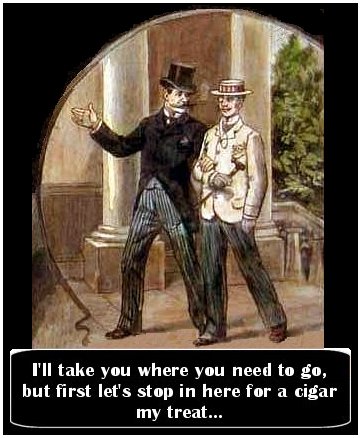
When a member of the Soap Gang needed help Jefferson was always ready
to lend a hand, whether it be money or legal aid. The men in the gang grew extremely loyal to their boss. At times the policemen
on the beat also sought his aid,
in help with situations where they had little power. This often occurred
in hard economic times when the poor population grew too large. The police called on the gambler's
of Denver to help with feeding the poor and Soapy's name was always at the top of the list
and rarely did he let them down. Jefferson had become so well known as a charitable man in Denver that Parson Tom Uzzell of the People's Tabernacle church often sought Jefferson's assistance, even knowing of Soapy's criminal
occupation. While giving a tour of the city one day, the parson and his entourage came across
Soapy. The good parson introduced Soapy as "The most infamous confidence man in American...and my friend."sought
his aid, in help with situations where they had little power.
This often occurred in hard economic times when the poor population grew too large. The police called on the gambler's of Denver to help with feeding the poor and Soapy's
name was always at the top of the list and rarely did he let them down. Jefferson had become
so well known as a charitable man in Denver that Parson Tom Uzzell of the People's Tabernacle
church often
sought Jefferson's assistance, even knowing of Soapy's criminal occupation. While giving a
tour of the city one day, the parson and his entourage came across Soapy. The good parson introduced Soapy as "The most
infamous confidence man in American...and my friend."
|
| Soapy's saloon and gaming hall, Denver, Colorado |
Steerers and boosters were always enthusiastic
about giving a potential dupe the proper (but bogus) means to win big at Soapy's games. One
of these was The Exchange, a fake stock market investment firm in which victims placed money
on a companies stock in hopes of winning a quick return on their wager. The Exchange was rigged
so that only the Soap Gang made a profit.
|
|
|
| CAVEAT EMPTOR! |
|
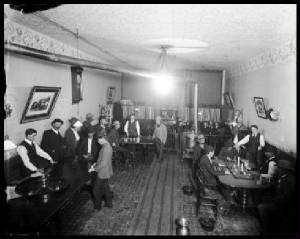
| Similar to what the upstairs Tivoli Club may have looked |
Jefferson became very successful at his chosen occupation
and opted to work out of his own establishments rather than give tribute to others for working out of their places of business.
He opened several gaming halls. One of these was the Tivoli Club at the corner of 17th and Market Streets. Faro and roulette
were popular at his club. Soapy was a true gambling addict and his game of choice was faro. He often played until he, or the
faro bank, was tapped out. As a legal loop-hole for the crooked gambling in the Tivoli Club Soapy placed
a sign at the entrance that read CAVEAT EMPTOR, Latin for "Let the buyer beware." It is probable that few
of his victims heeded the warning and fewer still could actually read Latin. Jeff's
younger brother, Bascomb, joined his older brother's gang in the late 1880s. Jefferson set him up in a cigar store business, which was used as a front for numerous swindles.
A card game was ever ready in the back room for times
when the steerers at the train station brought over a victim to fleece. Other businesses included fake policy and lottery shops, auction houses with expensive looking but cheap imitation
watches and diamonds for bidding. There were fake mining and mineral investment offices, that offered stocks in phony mining companies. In most of these establishments were the ever present
shell games and three-card Monte to further entice gambling
while the victim waited for services that were non-existent.
|
|
| "Streets of doom" |
|
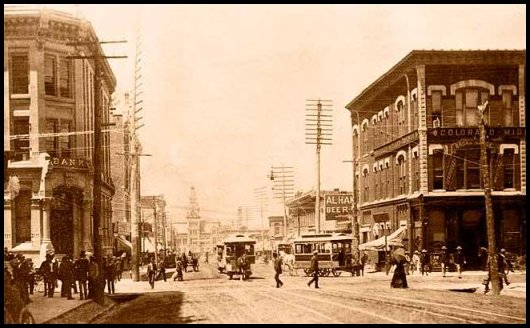
| Soapy's playground: Intersection of Seventeenth & Larimer streets |
|
|
|
The lower downtown
part of Denver on Seventeenth Street, between the Union
station and Larimer Street was known by some as the "Streets of doom." It was said that if a potential victim
could get from Union
Station to Larimer Street without giving any money to members of the Soap Gang then they would be relatively safe
from financial harm.
Soapy ran numerous businesses along Seventeenth Street, including the Tivoli Club on the south-east corner of Seventeenth and Market Streets. Soapy ran his organization
from an office in the Chever Block located on the
south-east corner of Seventeenth and Larimer Streets.
Soapy's empire organization needed a headquarters thus he opened an office in the Chever building on the
corner of Seventeenth and Larimer Streets from which to run his operations. Victims exiting trains from the station,
only a few blocks away, were led to one of Jefferson's numerous establishments where they were sure to find sure-thing
investments, a shell game or a good poker-hand in a friendly game of poker. By the time Soapy's victims left one of his
swindle shops their pockets were invariably emptied of ready cash. This was a daily occurrence in Denver between
1883-1895.
WOULD YOU LIKE TO KNOW MORE?
read
Alias Soapy Smith: The Life and Death of a Scoundrel
No images
or text may be used without prior written consent.
|
|
|
|