|
|
 |
|
|
ALASKA
AND THE
KLONDIKE
GOLD RUSH
1896-1898
"I beg to state that I am no gambler. A gambler
takes chances
with his money, I don't"
Jeff R. Smith, RMN 12/02/1894
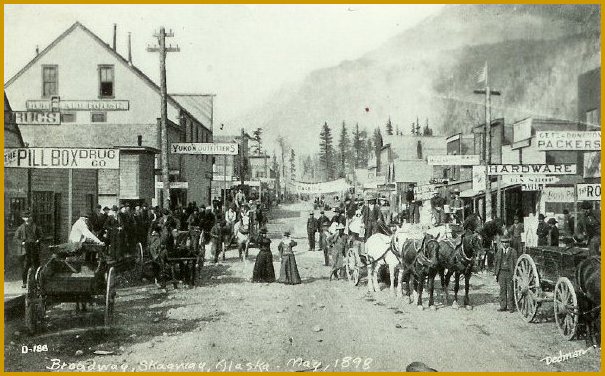
Broadway
Avenue, Skaguay, Alaska May 1898
|
|
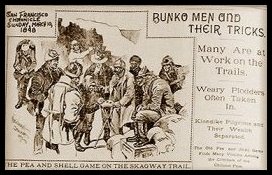
| Shell & pea men on the trails |
Soapy first set
foot in Alaska territory in 1896. News of small gold strikes were being more frequently reported. His gambler's instinct
told him that Alaska, "the last frontier," would produce the next big rush. He began surveying
the territory, seeking the right location to build his third empire.
The major gold strike in the Klondike occurred
in August of 1896, but because of the extreme winters, news of the strike did not reach the states
until 1897 when two ships filled with over two tons of gold
reached San Francisco, California, and Seattle, Washington. The rush Soapy knew was coming, had arrived.
Every ship sought the closest possible place to the Klondike possible, to drop off their human
cargo of stampeders. The steamer Queen, sailed up the Lynn Canal until it could go no further,
and dropped off the passengers on a beach head named Mooresville for its inhabitant, William Moore. It was renamed
Skaguay. With the arrival of the U.S. Postal service, the spelling
was changed to Skagway.
|
|
|
| Yukon Archives, Vogee Col. |
|
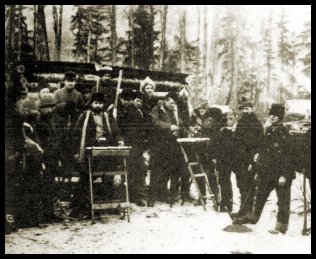
| Shell men along the Skagway trail |
Soapy Smith arrived at the tent city of Skagway very soon after its beginnings. He quickly set himself up in business
with John Clancy, a proprietor of a local saloon and set out to take over the camp's underworld as boss, just as he had
done in Denver and Creede. The narrow trail over the White Pass and into the interior was choked with stampeders, creating
a bottle neck, that led into and out of Skagway. The setting was perfect for the business men, as well
as the bunco men. The miners were in such a hurry to get onto the trail that the job of
the con man was all too easy. Even when caught red handed, victims rarely stayed around to enforce a complaint. If they did
decide to seek justice, it was quickly found that the deputy U.S. Marshal was not of much assistance, mainly due to the fact
that the marshal was in league with the soap gang. If a victim still insisted on justice, he had to go over to neighboring Dyea, five miles away,
to make an official complaint. Often times, the victim would find himself placed under arrest in order to keep him in town
for the hearing. All to often the victim was willing to accept
their losses in order to get back on the trail to the gold fields.
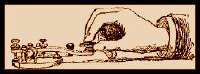
| "Messages sent to the states - $5" |
|
| Expect a reply...and a 'friendly' poker game |
One of the more humorous swindles, if one can find humor in it, was the
Skagway telegraph office. We see humor in it because of the gullibility and ignorance of the stampeders in regards to what
was available in Alaska. According to the legend, miners could send a message anywhere in the world for a mere $5. The humor
is that
There were no telegraph wires to or from Skagway
in the years 1897-1898.
|
Imagine how difficult it was to reach Skagway, Alaska, in 1897.
Ships were leaving the docks of Seattle, full with passengers, and the captains knew little of the route and it's dangers
to begin with. There were ships that actually got lost! Passengers spent a week or more on a ship that was nothing more than overloaded junk heaps, trying to get to Skagway. Once there, passengers and their gear were tossed ashore
as quickly as possible, so that the captain could quickly sail back to the states for more passengers. "Skaguay was like
an ant hill that had been stirred up by a stick wielding child," one old timer stated.
| Jeff Smith collection |
|
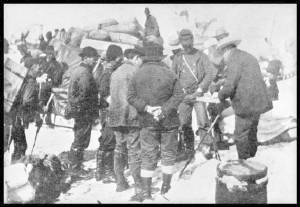
| A shell game along the trail |
Imagine yourself there, dropped off with a crowd in a new, little explored territory that is perhaps, thousands
of mile from home, and there it is, a telegraph office! Now you can send a message home, letting loved ones know you had arrived
safely. After paying your $5 and while the clerk is sending the message, he began to offer information on the region. He answers
all your questions, and in between he gathers information about you and your situation. Who are you traveling with? Where
are you headed and when? Do you have enough cash to make it through the winter? He seems to genuinely care and at the conclusion,
you leave the office satisfied, with new information and hope.
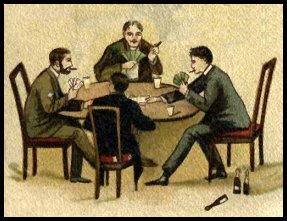
| "Have a seat...join the fun" |
|
| Soapy and the boys take in another victim |
Later, while taking in the sites of the new camp, you run into the friendly clerk again
and he informs you that you have received a reply to the message sent earlier. It is after hours
and the office is closed but he gladly offers to take you to the office and retrieve the telegraph message, if you pay the
additional $5 up front. After paying, the clerk takes you to his office. Inside there are a few
men sitting at a card table playing poker. Greetings are made as the clerk is informed by one of the men that his wife needs
him at their tent immediately. You are eagerly invited to sit in on the game and play a few hands
while you wait for the clerk to return. Before too long, you are out a large portion of your ready cash because you
were certain you held a "sure-thing" hand. Even if the though occurs to you later that you had been swindled, there
is no time to complain to the law and wait until justice is served. Every hour you waste not getting on the trail to the gold
fields, means more claims being staked out and that means less gold for you. chalking
up the loss to experience and hoping you will make up the loss with a new found gold strike, you hit the trail the next morning.
It
should not have been that hard to figure out that the telegraph office was a fraud. How in such a short time could the way
have been cleared, telegraph poles erected, and lines strung for over a thousand miles of forest, mountains, and rivers? A
telegraph cable to Juneau, just 100 miles away, was not laid until 1901. This does not mean we should condone the crimes,
but it sure makes the victim look just a little foolish. Who would be willing to go home and admit that they fell for such
a trick? Answer: There is no record of anyone admitting they had been taken this way.
|
|
|
|
|
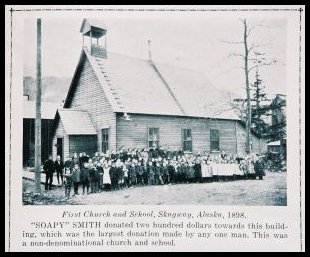
| Skagway's Union Church |
|
| Soapy is said to have aided the buildings erection |
The true story would not be complete if Soapy's good deeds
were not mentioned. In the book, The Reign of Soapy Smith, it reads, "Although he was
at odds with the law, many times he was the law's best friend." It should be known
that as bad as Soapy was, he also genuinely contributed to the towns he ran, and
was known for his huge donations to charitable causes. Skagway was no exception. Soapy was responsible for setting up or aiding
numerous charity funds that fed stray dogs, the hungry, the sick, the ungodly and the uneducated. When the town council asked
the residents to chip in so that a night watchman could be hired to guard the residential area, Soapy argued that one
was insufficient and donated enough money to hire two watchmen.
| Jeff Smith's Parlor |

|
| "Welcome to my Parlor," said the spder to the fly |
"Welcome
to my Parlor"
...said the spider to the fly
Soapy operated several saloons while
controlling Skagway, but the most famous was Jeff Smith's Parlor, opened in the spring of 1898. Skagway had a city hall
but many called Jeff Smith's Parlor, "the real city hall." It was from this saloon that Jeff oversaw his operations.
Early residents of Skagway say that there were two gangs
fighting for control of the city; the "real-estate grifters" and the "bunco men." As crime increased in
the city, the target of vigilante's became the easy crooks to define, the bunco men. It was easy for the real-estate grifters
to join in the fight with the vigilante's, but much more difficult for the bunco men, especially if their identities were
known.
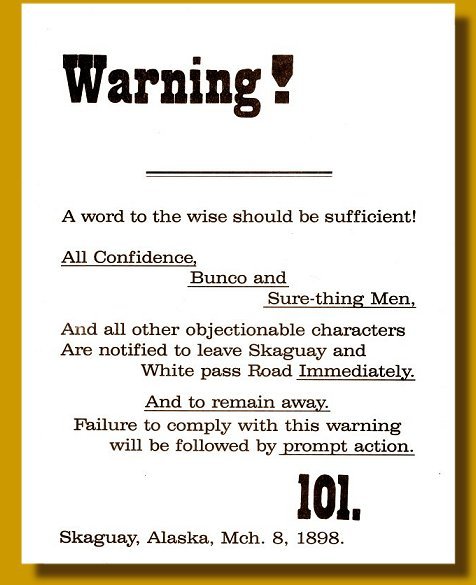
There were others that did not want Soapy in control. They secretly formed a vigilante
organization aimed at ridding Skagway of Soapy and his gang. The vigilantes printed up a handbill and posted them around the
camp and the trail.
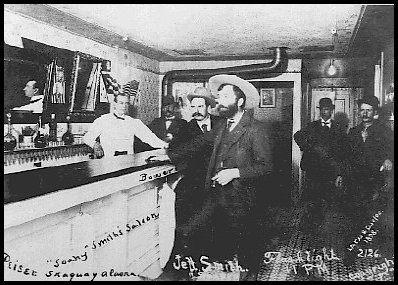
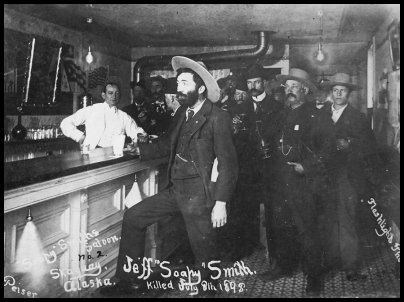
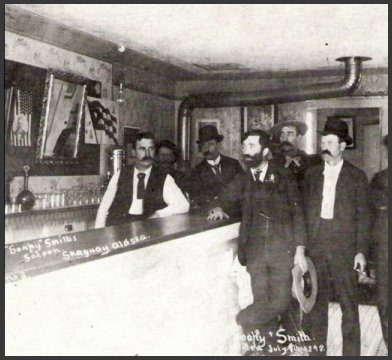
Three
of the most famous photographs of Soapy were taken inside Jeff Smith's Parlor believed between May 1 and July 4,
1898. Two were taken late at night.
| Photograph shot at 11 pm with aid of a flashlight |
|
| Partners Soapy Smith & John Clancy |
The
photograph above was taken at 11 pm at night with the aid of extra light from a flashlight. In the photograph are bartender
Nate Pollack, John Bowers in the back corner, John Clancy standing next to Soapy and two unidentified gentlemen.
| Late night drinking at Jeff Smith's Parlor |
|
| Soapy Smith & the Soap Gang |
Photograph
"No. 2" was also taken late at night by the same photographer and may have been taken on the same evening. More
of the gang are present. Note that the decorations on the walls are the same in both these photographs. Unfortunately they
are not dated but believed to be closer to July 1898.
| Captain Smith proudly poses |
|
| Clancy tends bar as Bowers and Soapy look on |
Definitely
a day time photograph taken by a different photographer. Note that the decor on the walls is different from the first
two pictures shown. Also note the emblem or pin of what appears to be a soldier on Soapy's lapel.
|
|
|
|
| Handbill from the Committee of 101 |
Most
bunco men would have heeded this warning, moving on to another location, but not Soapy Smith. The vigilantes did not realize
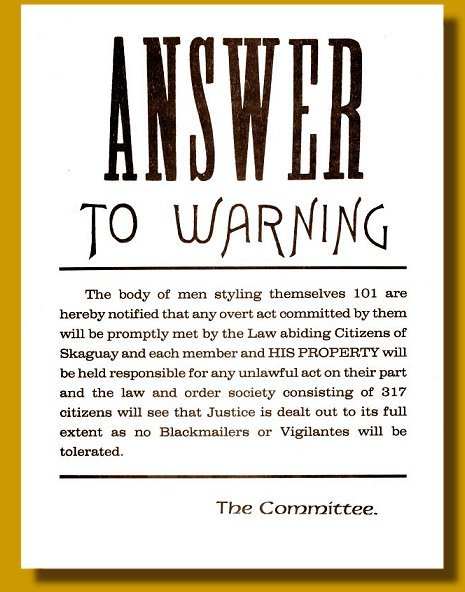
who they were dealing with. He called an informal town meeting and proclaimed the creation of his own law & order committee.
The following day the little city awoke to another handbill plastered about town.
|
|
|
|
| Handbill from the Committee of 317 |
Soapy's bluff worked. The vigilantes crawled back into hiding. There could
be no doubt that Soapy Smith was the supreme ruler, the uncrowned king of Skagway.
WOULD YOU LIKE TO KNOW MORE?
read
Alias Soapy Smith: The Life and Death of a Scoundrel
No images
or text may be used without prior written consent.
|
|
|
|