|
|
 |
|
|
Soapy's Weapons
Soapy
Smith, an expert gunman though not
a killer, probably never saw so many guns
as the owners have claimed were once
his.
Alaska Sportsman magazine, September, 1957
|
 Pictured here are some of the guns alleged to have once belonged
to Soapy Smith. Some are indisputable while others are questionable. As the quote at the top of the page from Alaska
Sportsman suggests, there are many more weapons then are shown here, that are claimed to have been Soapy's, but have
no provenance and we decided not to show them all here. Below is an authenticity rating that is listed with each
gun shown. This is my grading system and none are fool-proof, neither is it strictly guess work. It is governed by the available
information pertaining to each item. Disagreements are expected.
Authenticity
Rating Guide
1. Indisputable:
Provenance of ownership by Soapy exists.
2. Possible: Little to no provenance, but there is
circumstantial evidence.
3.
Slight: No
provenance and little, if any, circumstantial evidence.
4. None:
No provenance or circumstantial evidence.
J. M. Tanner, one of the vigilante guards on Juneau wharf the night Soapy
was killed, was later appointed a U.S. deputy marshal. It is written in Soapy's estate property reports that Tanner personally
handed Soapy's rifle to Soapy's son, Jefferson R. Smith III when he and his mother Mary (Soapy's widow) arrived
in Skagway, Alaska in August 1898. They had come to collect the estate. In later years it was reported that Tanner personally
gave away guns to people, claiming they had once belonged to Soapy. How many times he did this and what type of guns are not
known.
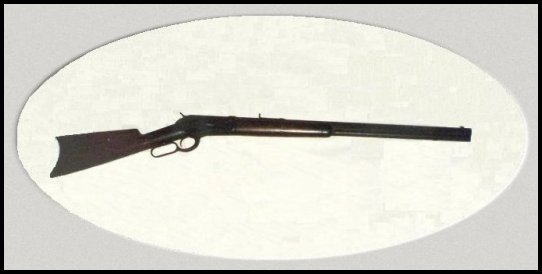
|
| The rifle Soapy died with |
The
photograph above shows the actual rifle Soapy used against Frank Reid on July 8, 1898. After shooting Reid, this rifle was
taken from Soapy's hands by vigilante guard, Jesse Murphy, and fired at least one round into Soapy's chest killing
him. It is a Winchester rifle, model 1892, 44-40, and was given to the son of Soapy a few weeks after the gunfight by acting
U.S. Deputy Marshal J. M. Tanner. The rifle currently remains in the Smith family. Authenticity
rating: Indisputable.
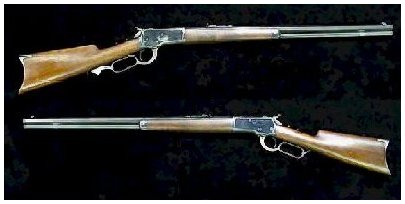
|
| Winchester model 1892 rifle, 44-40 |
This is not Soapy’s rifle but rather the same make and model for clearer
representation of the rifle Soapy owned.
|
|
|
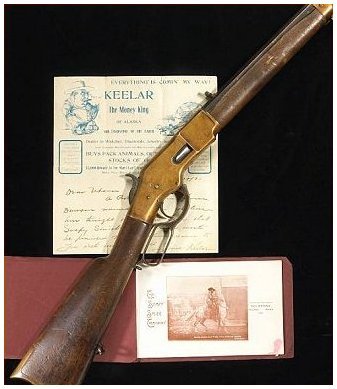
|
| The Havorsen Rifle |
An 1866 Winchester rifle, said to have been owned by Soapy that was sold or given away
by a merchant in Skagway.
On October 14, 2006 Douglas Halvorsen approached Jeff Smith wishing to sell this
rifle to him. Several email and phone conversations between October 14 and November 5, 2006, discussed at length the possibility
of ownership by Soapy Smith. Halvorsen insisted to Jeff that this rifle was the one Soapy used to kill Frank Reid and would
not accept Jeff's explanation that the real rifle had been given to the family in August 1898 by acting U.S. Deputy Marshal
Tanner and remains in family possession. Halvorsen stated that he had inherited his rifle, along with documents dated August
20, 1901, that state that his rifle was given or sold to another man. However the paperwork does not specifically identify
the rifle by model or other means, thus there is no way of knowing that the rifle in question was actually the one given away
in 1901. It is important to note that on several occasions residents of Skagway were known to give away weapons claiming that
it had once belonged to Soapy Smith.
John Culligan, our Historical Weapons Analyst states
that "the model 66 Winchester is a .44 rimfire, a relatively weak .44 caliber
compared to the .44-40 caliber. The next Winchester model manufactured was the model 1873, but the 1873 model was still nearly
identical to the model 66 in size, weight and the action ... a fairly heavy arm, even in carbine length. The next model that
used the .44-40, and other pistol cartridges, was the model 1892 rifle which was much lighter, shorter, and had a new action
that was stronger and required a lot less movement to lever in and fire another round." Photographs of Klondike stampeders
and merchant stores that sold equipment in Alaska during the 1897-1898 period clearly show a large preference for the newer
and more reliable model 1892. It is easily speculated that Soapy would have favored the model 1892 over the model 66 and model
1873.
The offer to purchase Halvorsen's
rifle was thoughtfully declined by the Smith family.
Auction description:
Lot 1349: A Winchester Model 1866 lever
action rifle attributed to outlaw Soapy Smith. Serial no. 121364 for 1873, .44 caliber. 24 inch octagonal barrel with full
magazine. Plain varnished walnut stock and fore-end. Sling swivels. Together with documentation attributing the gun to Jefferson
"Soapy" Smith comprising: 1) Letter on pictorial letterhead of Keelar The Money King of Alaska, reading "Dear
Upson/A Portland man from Dawson named Slavin will leave here tonight with the Gun that Soapy Smith killed Reid with he promised
me to deliver same to you with my compliments/Yours Keelar." With pictorial envelope postmarked Skagway 1901. Condition:
Gun: Good to very good. Barrel and tube with mottled brown patina showing some minor pitting. Action with dents and scratches.
Wood showing wear and scattered marks, left side of fore-end with large chip to left side and smaller chips to right. Paperwork
showing folds and minor tears. Footnote:
Details of the gunfight have never been made clear but it is known that Smith carried a rifle with which he shot Reid.
According to many sources it was a Model 1892 Winchester, whereabouts evidently unknown. The last remark in the footnote is the culmination of what Jeff Smith suspected. The
statement, "According to many sources it was a Model 1892 Winchester, whereabouts evidently unknown." is
an outright lie, instigated either by Halvorsen or Bohams/Butterfield Auction house. The conversation of the Soapy Smith
rifle and family possession of it are clearly noted in the email dated October 14, 2006 and in others dated later, as well
as was discussed thoroughly in several phone conversations. The rifle sold at Bohams auctions in San Francisco
on May 15, 2007 for $7,000 plus Premium and tax. Authenticity rating (the rifle that Soapy used against Frank Reid):
None Authenticity
rating (once owned by Soapy Smith): Slight to None
| Soapy's revolver rests beside his corpse |
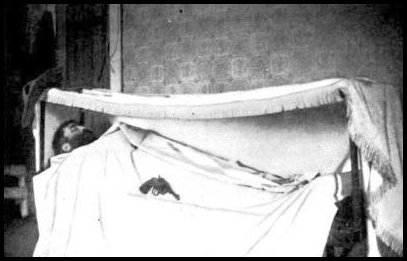
|
| Soapy Smith in the morgue |
|
|
|
|
| Close-up of Soapy's double-action revolver |
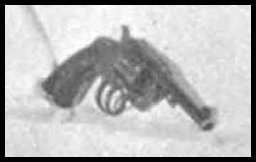
This is a close-up of Soapy's double action revolver that was placed
on his corpse in the morgue. Looking at the trigger clearly indicates that it is a double action. The make and model of this
revolver is harder to verify. It is most probably Soapy's but it is possible that someone placed the revolver there to
make the photograph more dramatic. Gun expert Larry Zeugl believes the revolver is either a model 1892 or 1895 Colt double
action with factory hard rubber grips. The model 1889 had factory wood grips. Authenticity rating: Possible
to Indisputable.
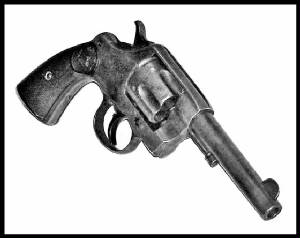
| Colt 1892 |
|
| Probable model of revolver Soapy owned |
The revolver shown at right is not Soapy's. In examining the only known photograph of Soapy's
pistol as it lay upon his corpse in the morgue, it can only be positively identified as a double-action. There are several
different brands of this style revolver that look very similar, therefore the actual model cannot
be positively determined. The Colt's model 1889 New Army (.41 caliber) and Navy (.38 caliber) double-action look
very similar, except that it had factory wooden grips, whereas the model 1892 and 1895 had factory rubber grips. This model
was very popular in 1898 during the Spanish-American War. Teddy Roosevelt carried one in battle
that had been salvaged from the USS Maine.
The New Army was first introduced in 1889, sometimes called the “.41 frame” for the original caliber
made. It was the basis for their very successful line of .38 and .41 caliber, New Army (.41) and Navy (.38) ancestor of the
Colt line of full size service revolvers.
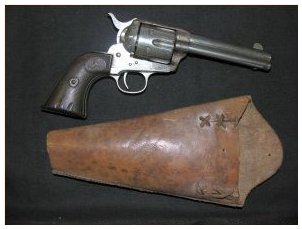
| The Selmer Revolver |
|
| Revolver said to be Soapy's |
This revolver is said to have originally belonged to Josias M. "Si" Tanner, who claimed that it once belonged
to Soapy. The gun was later acquired by Harriet Pullen and showcased in the famed Harriet Pullen Collection. Engraved
on the butt of the gun are J. M. Tanner Deputy U.S. Marshal. On the gun butt, near the hammer, it is engraved Soapy
Smith and H.S. Pullen 1898. The gun used to reside in a retail shop in Skagway on display in a glass case along
with other Soapy mementos and the Colt manufacturing paperwork. It is owned by Maxine Selmer. The fact that the gun may have
belonged to Tanner does cast some doubt on whether it was actually once owned by Soapy. Tanner has been accused of giving
away several guns to people, claiming that they were once owned by the legendary bad man. The authenticity of this revolver
remains a mystery. Authenticity
rating: Slight to Possible.
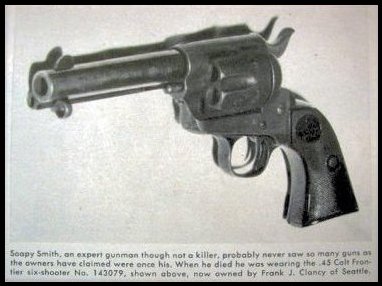
This revolver is said to have belonged to Soapy and obtained
by partner John Clancy in Skagway, Alaska, and passed down to John's son Frank J. Clancy. The serial number indicates
a manufacture year of 1891 but the grips are replacements made after 1895.
The write-up published with
this photograph in the September, 1957 issue of Alaska Sportsman magazine runs parallel to the general assumption
held by the Soapy Smith Preservation Trust, "Soapy Smith, an expert gunman though not a killer, probably never saw so
many guns as the owners have claimed were once his."
|
|
|
| Another angle of the Clancy revolver |
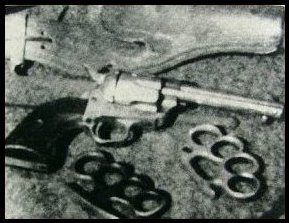
|
| Clancy revolver and brass knuckles said to be Soapy's |
Another angle of the Clancy revolver along with the holster and two brass
knuckles that supposedly belonged to Soapy Smith, published in the March, 1958 issue of Alaska Sportsman magazine.
The whereabouts of these items are unknown. Authenticity
Rating: Possible
|
|
|
|
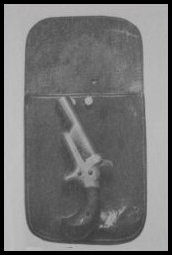
| The Rev. Sinclair Derringer |
This is a photograph of a Colt Model 3 Derringer .41 rim-fire that appears
in Mission: Klondike, the story of Reverend John A. Sinclair's adventures in Alaska and the Klondike during the
gold rush, written by the Reverend's son in 1978. The derringer is said to have been the derringer carried by Soapy. There
are two stories in the same book as to how he obtained the gun. In one chapter it is explained that in lieu of payment for
his services in the burial of Soapy, he asked for some personal memento of Soapy's. A vigilante gave him this gun and
said it was Soapy's. However, the caption with the photograph states that the gun was given to Reverend Sinclair by the
widow Smith.
|
|
It is unlikely that this gun was Soapy's. The main reasoning behind
this is that it is a rim-fire derringer made in the early 1870's. In 1898, the main cartridge used were center-fire. The
mere fact that Soapy might have owned such an outdated gun is foolish. Obtaining ammo for a rim-fire derringer in Alaska and
the Klondike would have to be next to impossible. It is believed that the Reverend was duped into accepting a worthless relic
as payment for his labor. Authenticity Rating: Slight to None.
|
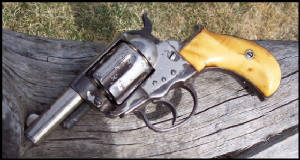
| The Zeug revolver |
This Colt model 1877 double-action .38 caliber revolver (SN#93432) was manufactured
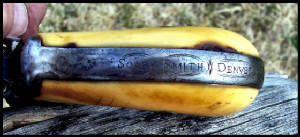
in 1893 and is owned by gun collector Larry Zeug. It is engraved "Soapy Smith Denver" on the back-strap. On the
inside of the ivory grip is the faint pencil name "Jeff." Gunsmiths were known to write the name of their customer
on the inside grips in order to make sure the right grips were placed on the right gun. It is improbable that Soapy himself
would have had the engraving done, neither would a friend have done so, as only Soapy's enemies and the newspapers called
him "Soapy." It is possible that rather than being given to Soapy, that Soapy may have given, loaned, or pawned
the revolver to someone, perhaps pawned in a gambling house, and a later owner engraved the back-strap. Other than the engraving
and name inside there is no provenance that it belonged to Soapy Smith.
| The Zeug revolver |
|
| back-strap |
The back-strap showing the "Soapy Smith Denver" engraving. Authenticity rating: Possible
WOULD YOU LIKE TO KNOW MORE?
read
Alias Soapy Smith: The Life and Death of a Scoundrel
No images
or text may be used without prior written consent.
|
|
|
|